


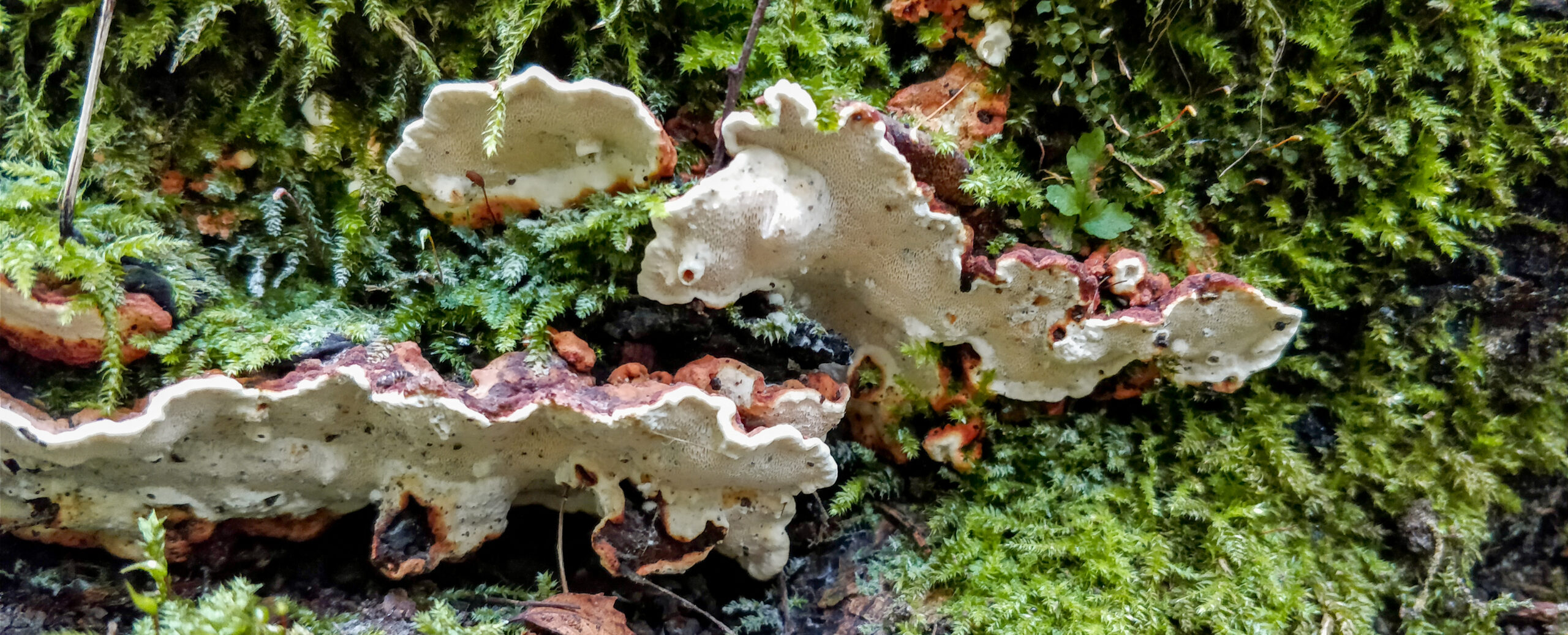
Root rot causes annual losses worth tens of millions of euros to the forestry industry.
Eeva Vainio, Research Professor at the Natural Resources Institute Finland, hunts for viruses that infect wood-decay fungi and studies their properties. The goal: to use these diseases to control decay fungi and save the forestry industry tens of millions of euros.
If you spot Research Professor Eeva Vainio out picking mushrooms, there’s no point trying to spy on her favourite foraging spots. In the forests of Espoo, Vainio isn’t looking for porcini or chanterelles. What interests this Natural Resources Institute researcher are root-rot fungi, honey fungus and other wood-decay species. And these are no minor organisms. The root-rot fungus Heterobasidion parviporum, for example, causes a disease in which the base and root system of a spruce tree can rot several metres up the trunk.
Wood-decay fungi rarely top anyone’s list of welcome finds. Besides being mostly inedible, they cost Finnish forestry tens of millions of euros a year. A single root-rot individual has been known to infect more than 50 trees. Honey fungus, meanwhile, sends long root-like threads through the soil, reaching from one tree to the next.
“For a researcher, wood-decay fungi are far more fascinating than the edible kind,” Vainio insists.
But fungi, captivating as they are, aren’t actually Vainio’s main focus. Her real interest lies inside them. Wild fungi harbour a rich variety of specialised viruses. Vainio hopes that one day these pathogens can be turned against the very decay fungi they inhabit.
Much about fungal viruses remains unknown. One thing, however, is certain: there are a great many of them. As detection techniques have improved, new viruses keep turning up. According to Vainio, almost every fungus examined so far has been found to carry viruses.
“Not necessarily every single individual, but nearly all the species we’ve studied have them,” Vainio says.
“And as our knowledge grows, it’s quite possible that fungi previously declared virus-free would turn out to harbour viruses too, if we analysed them again with today’s methods.”
Unlike animal viruses, fungal viruses rarely cause aggressive, fatal diseases in their hosts. Fungal viruses simply don’t spread very efficiently: transmission from one fungus to another typically requires physical contact or some kind of external carrier, such as an insect that picks up the virus from an infected cell and delivers it to a new individual. A virus that kills its host quickly, then, doesn’t have great prospects of its own.
Even within a single individual, a virus may not spread all that effectively. A root-rot fungus that covers an entire hectare, for instance, might have parts where infection stunts growth right alongside perfectly healthy sections.
“You can have an individual where half is infected and half isn’t. And yet it goes on living like that for decades or even centuries.”
Still, Vainio says she sometimes marvels at the sheer number of viruses.
“You’d think it would interfere with the cell’s functioning.”

Finding viruses in fungi is no easy task, because infection often leaves no visible trace. Viruses are also far too small to see under an ordinary microscope.
To find them, you have to look inside the cell. The most effective approach is to examine the RNA contained in a fungal cell. RNA can be thought of as a working copy of the genetic information stored in DNA.
Unlike DNA, which contains the entire genome, a single strand of RNA covers just one gene. It carries that gene’s instructions from the DNA onward, telling the cell which protein to produce.
Not all RNA in a cell necessarily comes from the cell’s own DNA, however. If a virus is present, it produces RNA of its own in an attempt to hijack the cell into making copies of it. When viral RNA is detected in a cell, the virus itself can be identified.
This amounts to assembling quite a jigsaw puzzle. An RNA analysis begins by breaking open the cell and collecting all the RNA molecules inside it.
Unfortunately, the process also chops that RNA into fragments roughly 100 base pairs long. From this mass, ribosomal RNA — responsible for the structure of the RNA — is identified and filtered out. What remains is around 100 million fragments of about a hundred base pairs each. Researchers then try to computationally reassemble these into intact sequences a few thousand bases long.
Putting together a puzzle like that is impossible without supercomputers.
Reassembling the RNA from a single fungal cell takes trillions of calculations. A supercomputer can do it in a matter of hours.
The use of supercomputers in fungal virus research is fairly recent. As a government agency, the Natural Resources Institute Finland gained affordable access to one only in 2020. It has, however, revolutionised virus discovery: new ones keep appearing.
“For a biologist, it’s always exciting to keep finding things that are new and unknown to science,” Vainio says.
“It’s a bit like going on an expedition without having to travel to the Amazon.”
Her research group has discovered dozens of previously unknown viruses.
Discovering viruses is only the beginning, though. After that, Vainio and her colleagues try to work out how the viruses spread and how they affect fungal behaviour.
One key question, for example, is whether a virus spreads via fungal spores and how effectively it transmits vegetatively to other fungal individuals.
In their analyses, Vainio and her team have also used Chipster, a software platform developed by CSC. It can be used, for example, to compare differences in gene expression between virus-infected and virus-free parts of the same fungal individual.
Vainio speaks highly of CSC’s services.
“The Chipster training course I attended years ago, for instance, was excellent.”
The search for fungal viruses is not purely basic research. The idea behind these projects is to find viruses that could be used to control root-rot fungi and other wood-decay species that cause major damage.
So is the plan to wipe out decay fungi with a pandemic?
“I’d say the aim is to prevent root rot and other fungal diseases from spreading at the scale they do today,” Vainio replies.
Fungal viruses generally spread too weakly for the word “pandemic” to apply. They don’t appear to be particularly lethal, either.
“But a virus that could stop an existing disease pocket from spreading or releasing spores would already be a good, natural control method. It could limit the disease from passing on to the next generation of trees.”
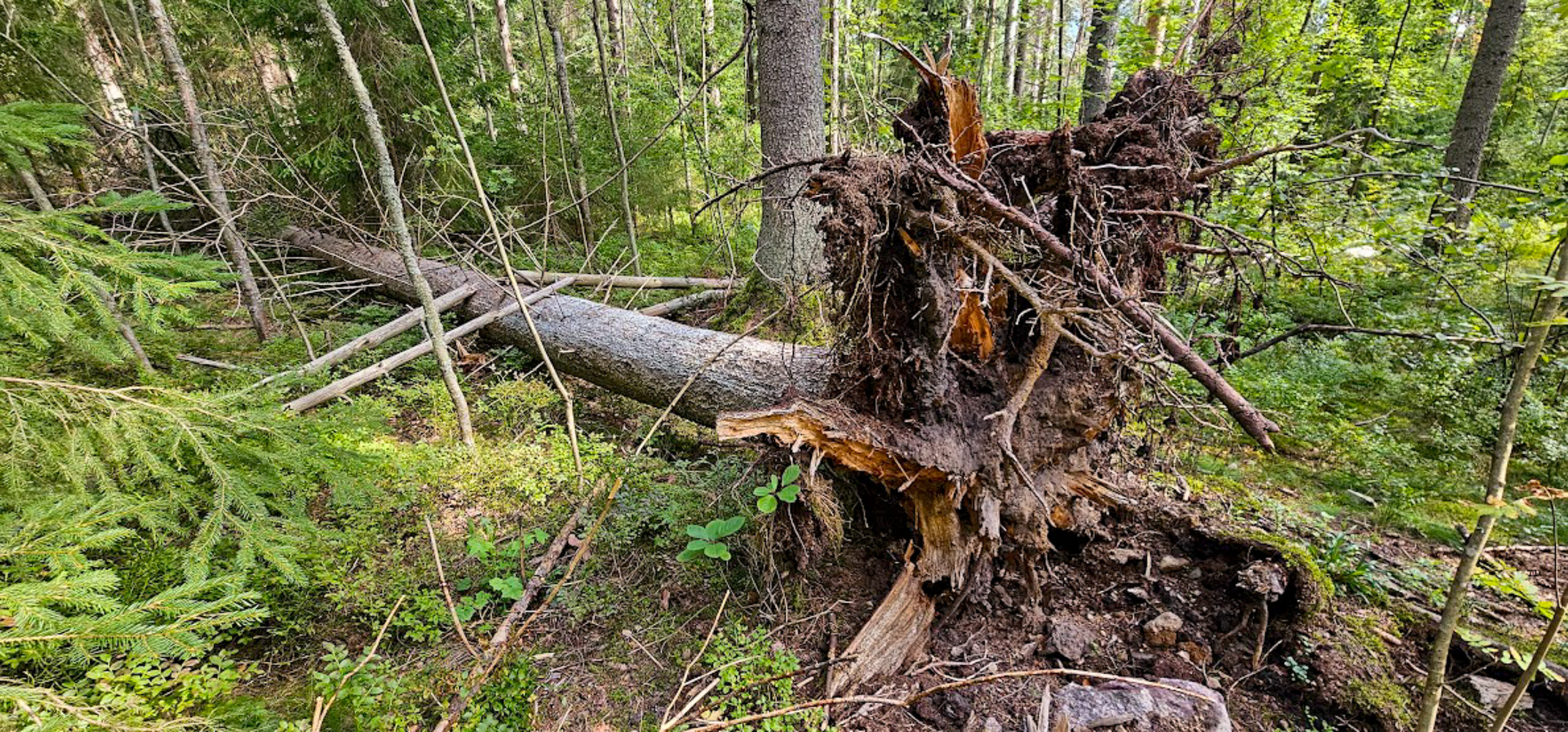
Using viruses to combat wild fungi may sound like a drastic intervention in the cycles of nature. In reality, however, the current spread of root rot is itself largely a consequence of human activity.
A clear-cut carried out in summer, leaving above-ground stumps behind, creates ideal conditions for decay fungi to spread. A fungus growing in a stump can propagate via both spores and underground root-like threads to nearby seedlings, which in a commercial forest are often the same species.
“In biodiverse natural forests, root rot has far fewer opportunities to spread,” Vainio points out.
“The stumps are surrounded by broadleaf trees that are less suitable as food for root rot, and the competing fungal communities are more diverse.”
Root rot became more common in step with the rise of summer felling. Treatment programmes introduced in the 1990s blocked spore-borne infections but did nothing to stop the fungus spreading through root systems.
Using viruses as a control measure, then, would be less about disrupting nature and more about restoring a more natural state of affairs.
Text: Juha Merimaa
Photos: Juha Merimaa and Eeva Vainio/Natural Resources Institute Finland
17 June 2026
Read the article in PDF format.
More information:
Software and training
Chipster is a bioinformatics analysis software developed by CSC, providing access to over 500 analysis tools.
CSC and ELIXIR Finland offer bioinformatics analysis training open to all.
https://csc.fi/en/training
https://tess.elixir-europe.org
CSC – IT Center for Science Ltd
is a non-profit limited company owned by the state and administered by the Ministry of Education and Culture. CSC maintains and develops the state-owned centralised information technology infrastructure.
https://research.csc.fi/cloud-computing
ELIXIR
is a distributed European infrastructure serving life science research. It offers, in a combined way, data resources, software tools, training, cloud services and high-performance computing resources from 23 countries and the European Molecular Biology Laboratory EMBL. Its Finnish node is CSC – IT Center for Science Ltd.


 ELIXIR is partly funded by the European Commission