


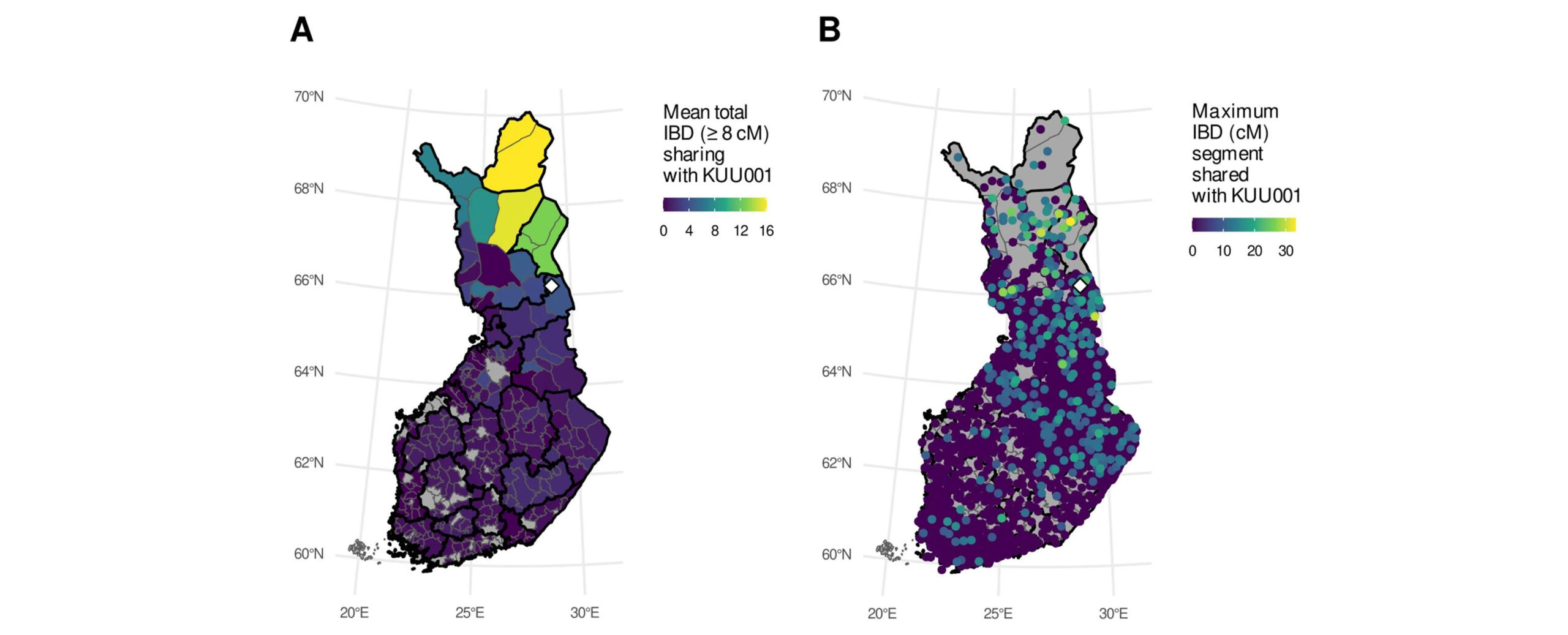
Map A shows how much ancestry present-day residents of different regions share with the shaman. Map B shows the same at the individual level: each dot represents a present-day person, and its colour indicates the length of the longest DNA segment shared with the shaman. Bright yellow indicates that genetic relatedness is concentrated in Lapland and northern Finland.
A 400-year-old shaman’s grave found in Kuusamo held a surprise: the chemistry of the teeth led all the way to Iceland. Professor Päivi Onkamo of the University of Turku and her research group read the past from ancient DNA and other ancient molecules – work that would be impossible without vast computing power and databases.
At some point around the turn of the 16th and 17th centuries, a person was laid to rest at Lake Kitka in Kuusamo.
This was no ordinary burial: buried with the deceased were a silver brooch and a bird-shaped pendant. The grave, found in 1970, was concluded to belong to a shaman – someone whose spirit was believed to be able to take the form of a bird and travel as one.
Little else was known about the deceased, however. It was unclear, for instance, whether they had been Sámi or were related to the present-day inhabitants of Kuusamo. Nor was it known whether they had come to Kuusamo from elsewhere or had lived there all along.
In 2019, Professor Päivi Onkamo of the University of Turku, an expert in evolutionary genomics, and her research group began studying the remains. They obtained samples from the deceased’s teeth, from which they examined not only the individual’s genetic makeup but also traces left in teeth of what the shaman had eaten and drunk during their life.
“On the genetics side, the analysis turned out to be fairly clear,” Onkamo says.
“Genetically, the deceased is clearly more closely related to the Sámi population of Lapland than to the present-day inhabitants of Kuusamo.”
The most interesting result, however, came from the dentin. It suggested that the shaman had spent time in Iceland during their life and had drunk the local mineral-rich water there.
“When we did follow-up research, it turned out that at that time, northern Finland and Iceland had established trade connections. So travelling between them was not unusual at all.”
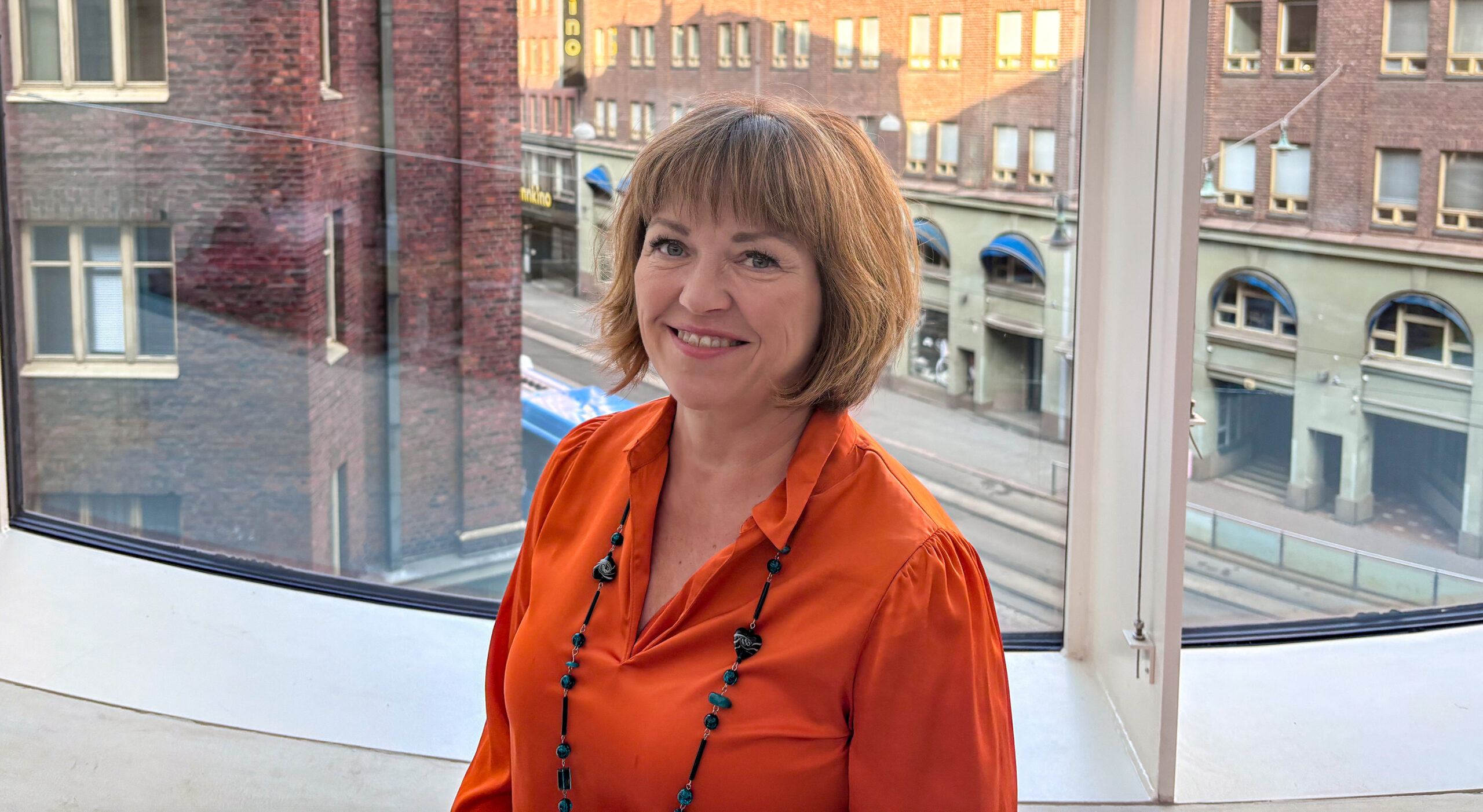
The Kuusamo shaman is just one example of Onkamo’s research. She and her group have spent much of the past decade working specifically with ancient DNA. Using DNA, she has studied prehistoric populations – for example, the origins, illnesses, migrations and diets of people buried in what is now Finland and western Russia.
Closer to home, one study looked at the extent to which 11th–century Pirkanmaa residents are related to the region’s present-day population. The research revealed a fairly clear connection.
Historical mysteries fascinate Onkamo, though she actually came to them by a roundabout route. History did not interest her at school.
“It felt like history books only dealt with wars and men in power.”
In a way, this is understandable: information from historical periods comes precisely from those in power, whose lives left written records behind.
Onkamo went on to study biology. In 2002, she earned her doctorate on mapping genes predisposing to childhood diabetes.
Around the same time, prehistoric research began moving closer to the natural sciences. Onkamo became part of that shift in 2006, when a doctoral student in archaeology told her he had heard about ancient DNA as a new field of research and wanted to combine genetics with archaeology. Onkamo became his doctoral supervisor.
The methods of the time, however, did not yet allow for DNA sequencing of the kind done today. Instead, the work consisted of population genetic simulations and analysis of radiocarbon dating.
“Analysis of ancient DNA of the kind we do today has only been possible for about 15 years,” Onkamo says.
Analysing an ancient DNA sample may sound fairly straightforward to a layperson: you simply take a tissue sample and analyse it like any other.
Unfortunately, things are not quite that simple, Onkamo says.
Even obtaining a sample is usually the result of a lengthy process.
“Most of the ancient samples we analyse come from museum collections. Even though we don’t need a large sample, every piece taken from an ancient tooth or bone makes the sample smaller, and it is destroyed in the analysis.”
It is therefore quite understandable that permits to take samples are only granted after careful consideration.
Carrying out the analysis is not easy either. Samples are often contaminated in many ways, meaning they contain DNA from several different sources: they may contain the genetic material of microbes from the soil in which the sample lay buried, DNA from the researchers who handled it, and even the genetic material of microbes and viruses that lived in the deceased’s body.
“From this so-called metagenomic mixture, we then try to identify the sample’s own DNA sequences,” Onkamo explains.
It doesn’t help that ancient DNA is often fragmented and incomplete. The analysis resembles a jigsaw puzzle where the pieces come from many different puzzles, but none of them is complete.
In practice, the work requires high-performance computing to sort out the right pieces from among the rest. For this, Onkamo’s group uses supercomputers at CSC – IT Center for Science, such as Mahti and Puhti.
A complete genome is almost never obtained, however. Fortunately, this is not necessary.
“About 1.2 million marker sites have been defined in human DNA, and by examining these you can get a fairly good idea of which population an individual came from and who they might be related to,” Onkamo says.
“If we manage to analyse even around 300,000–400,000 of these, we already have a fairly good picture of what genetic variation the deceased carried.”
Analysing the sample, however, is only part of the whole picture. The markers are useless if the sample cannot be compared against databases.
“A single analysis requires many different data sources,” Onkamo describes.
Many of the databases they use are international, such as ancient DNA databases, but also modern-day DNA data resources, such as the European Nucleotide Archive (ENA), the HUGO Gene Nomenclature Committee (HGNC), and the Genome-Wide Association Studies (GWAS) Catalog. All three are ELIXIR Core Data Resources. Modern comparison data is obtained by the group from, among others, biobanks and THL, the Finnish Institute for Health and Welfare.
“Without these databases, doing this work would be impossible.”
The development of these analyses is therefore not just a matter of advancing techniques, but also of the growing availability of reference data.
Analysis is not always easy, though.
“For example, the data managed by THL has been collected in many stages and for several different purposes. Simply harmonising and combining the samples for analysis was a huge task that took two bioinformaticians almost a year.”
In practice, an ancient sample analysis can take several years from obtaining the sample to a finished result – and that doesn’t include the time spent acquiring the sample or publishing the results.
Sometimes the result can be a little disappointing.
“Occasionally we have to conclude that the subject of the analysis is nothing like what was expected. The remains were probably mixed up at some point during storage, and remains thought to be from the Bronze Age turn out to be medieval and from a completely different part of Europe.”
Analysing ancient DNA is, in other words, anything but easy. At the same time, it provides information about the past that would otherwise remain hidden.
In many ways, genetics can be said to have revolutionised archaeology in the 21st century.
“We have gained completely new information about how people have moved. For example, we can show that, in a certain period and area, men often came from elsewhere while women were related to the area’s earlier inhabitants. This tells us about the mixing of populations.”
Non-human DNA found in the sample can also be interesting.
“We can find, for example, traces of pathogens, which can tell us whether the deceased was ill with something when they died, or whether they may have died of a disease.”
In the future, Onkamo hopes to broaden the research to cover ever more of the DNA present.
“Right now we focus only on the deceased’s own DNA and possible pathogens, but at the same time, as much as over 90 percent of the DNA present in samples goes unidentified. By examining that, we could find out what kinds of soil microbes surrounded the body in the grave. Could that then tell us something about the burial conditions? The soil itself can be interesting too.”
This kind of research, however, would require even more computing power and even larger databases.
“I’d say we are only at the beginning of what we can reveal about the past through DNA analysis. But it’s true that it will take resources.”
Photos: Juha Merimaa and Päivi Onkamo’s research group.
CSC – IT Center for Science Ltd
is a state-owned, non-profit company administered by the Ministry of Education and Culture. CSC maintains and develops Finland’s state-owned centralised IT infrastructure.
research.csc.fi/cloud-computing
ELIXIR
is a distributed European research infrastructure for life science data. It provides combined access to data resources, software tools, training, cloud services and high-performance computing resources from 23 countries and the European Molecular Biology Laboratory (EMBL). Its Finnish node is CSC – IT Center for Science Ltd.


 ELIXIR is partly funded by the European Commission